The State of Online Assessments in India 2026: A Report on Integrity, Infrastructure, and Innovation.
The landscape of examinations and corporate testing in India has reached a critical, make or break turning point. Driven by an astronomical rise in high speed connectivity, remote workforces, and an urgent national mandate to wipe out paper leaks and AI assisted fraud, the digital evaluation ecosystem is undergoing a massive, structural overhaul. According to market data from the IMARC Group, India’s broader e- learning market surged to $9.13 billion and is on pace to explode to $23.18 billion by 2034. Concurrently, user penetration within the country's online education sector is projected to hit 15.0%, as highlighted by eLearning Stats.
This report provides a comprehensive, data driven analysis of the key trends, high stakes challenges, and technological innovations defining online assessments in India today.
1. Key Market Drivers: The Corporate Shift to Real Competence
India’s massive student demographic and sprawling corporate sector have turned scalable evaluation into a matter of national economic survival. Unreliable pen and paper formats and basic quiz builders are rapidly losing ground to sophisticated infrastructure due to two primary growth engines:
- Massive Infrastructure Expansion: India's total internet user base has expanded to a staggering 954.40 million subscribers, creating an unprecedented, nationwide foundation for digital testing networks, as cited by the IMARC Group.
- The Corporate Upskilling Mandate: Enterprises are completely abandoning passive "completion tracking." The Indian corporate e- learning market reached a staggering $11.2 billion, according to the IMARC Group's Corporate Report. To back this digital push, the Indian government allocated ₹551.75 crore ($66M USD) to the IndiaAI Mission, prompting businesses to integrate automated assessment tools to guarantee employees acquire real, verifiable skills rather than empty paper certificates.


2. The Integrity Crisis: Systemic Leaks and GenAI Defiance
Despite rapid technical progress, security vulnerabilities have threatened to undermine public and institutional trust. High profile incidents have exposed severe structural flaws across multiple assessment formats:
- The Logistical Failure of Physical Formats: Large scale national entry examinations faced historic disruptions. High profile paper leaks forced the NTA to issue emergency guidelines for comprehensive re- exams, disrupting the futures of hundreds of thousands of aspirants. This administrative nightmare sparked intensive federal probes by the CBI to dismantle organized leak networks.
- The GenAI Disruption: The widespread availability of generative tools like ChatGPT has rendered simple browser lock quizzes obsolete. Data shared by eLearning Stats indicates that over 26% of students actively use generative AI for academic work. Candidates can easily bypass basic surface level webcam tracking using virtual machines, dual monitors, or hidden hardware peripherals to feed test questions directly into AI interfaces.
3. Emerging Solutions: The Rise of Defensible Verification Tech
To protect institutional reputations, the market has pivoted toward advanced security ecosystems. Globally, the online assessment software market is accelerating to $5.31 billion, according to The Business Research Company, driven directly by the demand for secure proctoring.
In India, platforms like DigiProctor are establishing a new benchmark by shifting from passive observation to multi- layered digital custody. The blueprint for modern online assessments in India now relies on an absolute, three tiered security strategy:
- Deep Operating System Containment: Moving past superficial browser extensions, modern systems secure the entire operating system. This successfully blocks background collaboration software, unauthorized extensions, screen sharing tools, and virtual machines.
- Just- in- Time Cloud Delivery: To permanently solve the threat of paper leaks, question banks are encrypted on secure cloud servers and pushed directly to active client screens moments before the test begins, completely removing physical transit risk.
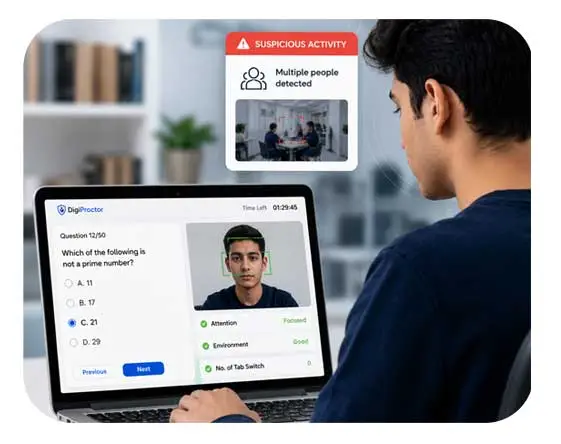
- Environmental and Acoustic Intelligence: Beyond tracking basic eye movements, advanced platforms audit acoustic frequencies and hardware connections to identify hidden Bluetooth earbuds, secondary smart devices, or external proxy assistance.

4. Conclusion and Outlook
The state of online assessments in India proves that basic surveillance is no longer enough to guarantee evaluation validity. Whether confirming a medical candidate's qualifications or verifying an enterprise employee's compliance readiness, the future belongs to robust, automated testing environments that preserve candidate dignity while enforcing absolute digital security.
Book a Demo